Riflessione sull'America di Trump
Trump continua a menarcela sul fatto che "la NATO e gli europei non c'erano per l'America"


postato da angelo consoli @ 02:24
0 Commenti


Trump continua a menarcela sul fatto che "la NATO e gli europei non c'erano per l'America"
postato da angelo consoli @ 02:24
0 Commenti


postato da angelo consoli @ 09:00
0 Commenti
Antonella Sberna, elected to the European Parliament for Fratelli d'Italia, the Party of Prime Minister Georgia Meloni, is now Vice President of the European Parliament.


postato da angelo consoli @ 09:05
0 Commenti
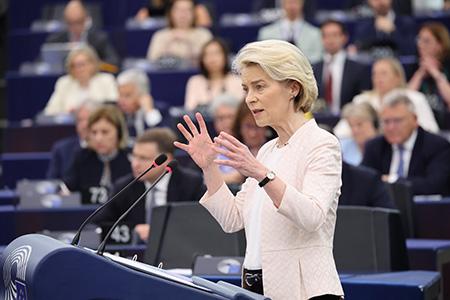
“Check against delivery”
Dear President Metsola, dear Roberta,
Let, me first congratulate you from the bottom of my heart for your re-nomination. Your success is a mirror of the outstanding work you have been doing in this House of European Democracy.
Honourable Members,
It is now five years since I first came to ask for your confidence. Five years like no other in our Union's history. I will always remember the spine-tingling moments we shared together in this hemicycle. From standing in front of you, asking for your confidence five years ago to proposing NextGenerationEU. From the appearances of President Zelenskyy when even the translators could not hold back their tears to the empty chair poignantly left out for Alexei Navalny as his daughter spoke on his behalf. From the moments of silence for those we lost in the pandemic to the moments of song for the Ode to Joy or Auld Lang Syne. And I will never forget the last words of David Sassoli calling for a more united Europe. This Parliament understands the weight of this moment's history.
Honourable Members,
Choices are the hinges of destiny. And in a world full of adversity, Europe's destiny hinges on what we do next. Despite the momentous things we have done and overcome, Europe now faces a clear choice. A choice which will shape our work for 5 years and define our place in the world for the next 50. The choice comes down to whether we will be shaped by events and the world around us or whether we will come together and build our future for ourselves. And that choice is ours. Europe cannot control dictators and demagogues across the world, but it can choose to protect its own democracy. Europe cannot determine elections across the world, but it can choose to invest in the security and defence of its own continent. Europe cannot stop change, but it can choose to embrace it by investing in a new age of prosperity and improving our quality of life.
But, Honourable Members, for us to choose the Europe of tomorrow, we must acknowledge how people feel today. We are in a period of deep anxiety and uncertainty for Europeans. Families are feeling the pain from the cost of living and housing. Young people are concerned about the planet, their future and the prospect of war. Companies and farmers are feeling squeezed. All of this is a symptom of a world in which everything is weaponised and contested. Where there is a clear attempt to divide and polarise our societies. I am deeply concerned about these trends. But I am convinced that Europe – a strong Europe – can rise to the challenge. And this is why I am asking for your confidence today. Because, just like you, I came into politics to make a difference for all of society to deliver for the generation of my children and grandchildren, like those who came before us did. I am convinced that the version of Europe since the end of World War II, with all of its imperfections and inequalities, is still the best version in history. I will never stand by and watch it be torn apart from the inside or the outside. I will never let the extreme polarisation of our societies become accepted. And I will never accept that demagogues and extremists destroy our European way of life. And I stand here today ready to lead this fight with all of the democratic forces here in this House.
Honourable Members,
This is the vision I have set out in my Political Guidelines. A vision of a stronger Europe that delivers prosperity, that protects people and that defends democracy. A stronger Europe that delivers social fairness and supports people. A stronger Europe that implements what it agrees in a fair way. And that sticks to the targets of the European Green Deal with pragmatism, technology-neutrality and innovation. I have listened carefully to the democratic forces in this Parliament and I am convinced that these Guidelines reflect how much we have in common, despite the differences that are healthy in any democracy.
Honourable Members,
Our first priority will be prosperity and competitiveness. In the last five years, we have weathered the fiercest storm in our Union's economic history. We have emerged stronger from the shock of lockdowns, and we have overcome an unprecedented energy crisis. We did this together, and I believe we can be proud of it. But we also know that our competitiveness needs a major boost. The fundamentals of the global economy are changing. Those who stand still will fall behind. Those who are not competitive will be dependent. The race is on and I want Europe to switch gear. And this starts with making business easier and faster. We need to deepen our Single Market across the board. We need less reporting, less bureaucracy, and more trust, better enforcement and faster permitting. And I will ensure that we are accountable for this. Because only what gets measured gets done. Therefore, I will task each Commissioner to deep dive in their portfolio, and to deliver concretely on burden reduction. And I will appoint a Vice-President to coordinate this work and to report on progress to this House once a year. I will also introduce a revamped SME and competitiveness check as part of our Better Regulation toolbox. We all know there is no Europe without SMEs. They are the heart of our economy. Therefore, let us get rid of the burdensome micromanagement, and give them more trust and better incentives.
Honourable Members,
Let me give you some figures. To start: in the first half of this year, 50% of our electricity generation came from renewables – home-grown and clean. Investments in clean technologies in Europe have more than tripled in this mandate. We attract more investments in clean hydrogen than the US and China combined. Finally, in the last years, we have concluded with global partners 35 new agreements on clean tech, hydrogen and critical raw materials. This is the European Green Deal in action. So I want to be clear. We will stay the course on our new growth strategy and the goals we set for 2030 and 2050. Our focus now will be on implementation and investment to make it happen on the ground. This is why I will put forward a new Clean Industrial Deal in the first 100 days. It will channel investment in infrastructure and industry, in particular for energy-intensive sectors. This will help create lead markets in everything from clean steel to clean tech and it will speed up planning, tendering, and permitting. We must be faster and simpler. Because Europe is decarbonising and industrialising at the same time. Our companies need predictability, for their investments and innovation. And yes, they can rely on us. In this logic, we will enshrine our 90% target for 2040 in our European Climate Law. Our companies need to plan their investments for the coming decade already today. And this is not only about business. For our young people, 2030, 2040, 2050 is around the corner. They know that we have to reconcile climate protection with a prosperous economy. And they would never forgive us if we do not rise to the challenge. So, this is not only a matter of competitiveness, but also a matter of intergenerational fairness. The young people deserve it.
The new Clean Industrial Deal will also help bring down energy bills. We all know that structurally high energy prices hamper our competitiveness. And high energy bills are a major driver of energy poverty for people. I have not forgotten how Putin blackmailed us by cutting us off from Russian fossil fuels. But we withstood together. We invested massively in homegrown cheap renewables. And this enabled us to break free from dirty Russian fossil fuels. Therefore, together, we will ensure that the era of dependency on Russian fossil fuels is over. Once and for all.
Honourable Members,
Europe needs more investment, from farming to industry, from digital to strategic technologies but also more investment in people and their skills. This mandate has to be the time of investment. This starts with completing our Capital Markets Union and mobilising more private financing. Every year EUR 300 billion of European families' savings go from Europe to foreign markets, because our capital market is too fragmented. And then this money is often used to buy innovative European companies from abroad. This has to change. We need to leverage this enormous wealth to create growth here in Europe. This is why we will propose a European Savings and Investments Union. European start-ups should not need to look at the US or Asia to finance their expansion. They must find what they need to grow right here in Europe. We need a deep and liquid capital market. And we need a competition policy that supports companies to scale up. Europe must be the home of opportunity and innovation.
Honourable Members,
To unleash private investment, we also need public funding. Yes, we have the resources in NextGenerationEU and the current budget. But this will come to an end within the next few years. While our investment needs will not. We need more investment capacity. Our new budget will be reinforced. It must be more focused on policies, simpler for Member States and more impactful, so that we use its power to leverage more private and public financing. And I will propose a new European Competitiveness Fund. It will be focused on common and cross-border European projects that will drive competitiveness and innovation – notably to support the Clean Industrial Deal. It will ensure that we develop strategic tech and manufacture it here, in Europe. So, from AI to clean tech, the future of our prosperity must be made in Europe.
Honourable Members,
We must also invest more in our security and defence. Russia is still on the offensive in East Ukraine. They are banking on a war of attrition, on making the next winter even harsher than the last. Russia is banking on Europe and the West going soft. And some, in Europe, are playing along. Two weeks ago, an EU Prime Minister went to Moscow. This so-called peace mission was nothing but an appeasement mission. Only two days later, Putin's jets aimed their missiles at a children's hospital and maternity ward in Kyiv. We all saw the images of children covered in blood, and mothers trying to bring young cancer patients to safety. That strike was not a mistake. It was a message. A chilling message from the Kremlin to all of us. So, Honourable Members, our answer has to be just as clear. No one wants peace more than the people of Ukraine. A just and lasting peace for a free and independent country. And Europe will stand with Ukraine for as long as it takes.
Honourable Members,
We must give Ukraine everything it needs to resist and prevail. This implies making fundamental choices for our future. For the first time in decades our freedom is under threat. It is our responsibility to do all that is necessary to protect our European citizens. Protecting Europe is Europe's duty. I believe now is therefore the time to build a true European Defence Union. Yes, I know there are some who are perhaps uncomfortable with the idea. But what we should be uncomfortable about are the threats to our security. Let us be clear: Member States will retain responsibility for their national security and their armies. And NATO will remain the pillar of our collective defence. But we all know very well that our spending on defence is too low and ineffective. Our foreign spending is too great. We must therefore create a single market for defence. We must invest more in high-end defence capabilities. In other words, Europe must continue along the path laid down by the Versailles Declaration. We need to invest more. We need to invest together. And we must set up common European projects. For example, a comprehensive aerial defence system – a European Air Shield, not only to protect our airspace but as a strong symbol of European unity in defence matters.
Honourable Members,
Security is not only about external threats. Cyber and hybrid threats are growing. Organised criminal networks are infiltrating our economy; most of them use corruption. They are causing fear and innocent people's death with their brutal violence. They earn enormous amounts of money from drug trafficking, ransomware, fraud, trafficking in human beings and they are not limited by national borders. It is necessary that we respond to this growing threat on a European level. We must make sure that police can work across Europe without borders. This is why I will propose to double Europol's staff and strengthen its mandate. I want Europol to become a truly operational police agency.
And we must also do more to secure our external borders. Our Eastern Border in particular has become a target for hybrid attacks and provocations. Russia is luring migrants from Yemen up north and pushing them deliberately against the Finnish border. We should always keep in mind that a Member State's border is a European border. And we will do everything we can to make them stronger. This is part of the reason why we must strengthen Frontex. To make it more effective, while fully respecting fundamental rights, I will propose to triple the number of European border and coastguards to 30,000.
More secure borders will also help us to manage migration in a more structured and fair way. The Migration and Asylum Pact is a huge step forward. We put solidarity at the heart of our common response. Migration challenges need a European response with a fair and firm approach based on our values. Always remembering that migrants are human beings like you and me. And all of us, we are protected by human rights. Many pessimists thought that migration was too divisive to agree on. But we proved them wrong. Together we made it. And we have emerged stronger from it. Now, we must collectively focus on implementation and on supporting Member States in making it a reality on the ground. And there will be more to do. We need a common approach on returns, to make them more effective and dignified. And we need to develop our comprehensive partnerships, in particular across our Southern neighbourhood. The Mediterranean region should get undivided attention. This is why I will appoint a Commissioner for the region, and propose a new Agenda for the Mediterranean together with Kaja Kallas. Because the future of the two Mediterranean shores is one and the same.
Honourable Members,
Our neighbourhood is home to our future. Inviting countries into our Union is a moral, a historical and a political responsibility. It is an enormous geostrategic responsibility for Europe. Because in today's world a larger Union will be a stronger Union. It will strengthen our voice in the world. It will help reduce our dependencies. And it will ensure that democracy, prosperity and stability spread across Europe. We will support candidates, by working on investment and reforms and integrating them where we can into our legal frameworks. Accession will always be a merit-based process. And we will ensure that all countries are ready, before joining. But completing our Union is also in our core interest. And it will be a core priority for my Commission. History is calling once again. The Western Balkans, Ukraine, Moldova and Georgia have made their free choice. They have chosen freedom over oppression. They have chosen democracy over dependency. And some of them are paying a high price for this choice. So we must make our choice, and show steadfast commitment. Their future will be free and prosperous, inside our Union.
Honourable Members,
Europe has a responsibility to play an active role in the world, starting in our neighbourhood and in particular in the Middle East. I want to be clear: the bloodshed in Gaza must stop now. Too many children, women and civilians have lost their lives as a result of Israel's response to Hamas' brutal terror. The people of Gaza cannot bear any more. Humanity cannot bear it. We need an immediate and enduring ceasefire. We need the release of Israeli hostages. And we need to prepare the day after. Europe must play its part. We have massively increased our humanitarian aid to almost EUR 200 million in 2024. And we will do more. We are now working on a much larger multi-year package to support an effective Palestinian Authority. The two-state solution is the best way to ensure security of both, to Israelis and Palestinians. People in the Middle East deserve peace, security and prosperity. And Europe will be at their side.
Honourable Members,
Europe offers a unique quality of life. From comprehensive social security to first-class regional food products. Rapeseed fields, vineyards and fruit orchards not only mean good food and drink, they are also part of our homeland. And that is why the future of agriculture is such an important and sensitive issue for us in Europe. We must overcome differences and develop good solutions together with all stakeholders. That is why I launched the Strategic Dialogue on the Future of Agriculture in Europe. It brings farmers, environmental groups and experts from across the food chain to the table. I have promised to listen to them carefully and to learn from them. And I shall do so. I will take on board good recommendations and present a new European strategy for our agriculture and the food sector. I will make sure that farmers receive a fair income. No one should be forced to sell good food below production costs. We must strengthen the position of our farmers in the food industry value chain. And we need smarter incentives and more innovation and access to capital. Anyone who manages nature and biodiversity in a sustainable way and helps to balance the carbon budget must be properly rewarded. Our farmers shape our landscapes. They shape the face of Europe. They are part of our culture. They provide food security. And we are proud of them.
That is why we must work together to tackle the problems bearing down on them. They feel climate change. Every year they are more and more affected by extreme weather and water scarcity. Temperatures in Europe are rising twice as fast as the global average. We are already seeing the devastating effects on fields and in forests. The face of our rural communities is changing. We must do more to ensure that our farmers are better prepared for what climate change holds in store for us. That is why I will present a plan for agriculture to address the need to adapt to climate change and, in parallel, a strategy for sustainable management of the precious resource of water. Not only our food security depends on it, but also our overall competitiveness.
Honourable Members,
Our quality of life and our very social fabric are unique. We made historic steps forward on our Pillar of Social Rights – from minimum wages to the first-ever Child Guarantee. During the pandemic, we saved 40 million jobs with SURE. And we can be proud of that. But many new challenges have emerged – from the impact of AI to mental health at work and new drivers of poverty. We need a new action plan for the implementation of the Pillar. We must ensure fair transitions and good working conditions for workers and self-employed people. And crucial for that is Social Dialogue – the hallmark of our social market economy. We will therefore work to increase collective bargaining and strengthen European Social Dialogue. And we will address those issues that Europeans feel the most in their daily lives. Take housing. Europe faces a housing crisis, with people of all ages and families of all sizes affected. Prices and rents are soaring. People are struggling to find affordable homes. This is why, for the first time, I will appoint a Commissioner with direct responsibility for housing. We will develop a European Affordable Housing Plan, to look at all the drivers of the crisis and to help unlock the private and public investment needed. Typically, housing is not seen as a European issue. Some might say we should not get involved. But I want this Commission to support people where it matters the most. If it matters to Europeans, it matters to Europe.
Honourable Members,
This is how we can strengthen our society. This means ensuring that every region, in every part of Europe, is supported. No one is left behind. I am committed to a strong cohesion policy, designed together with regions and local authorities. I want Europe to be the best place to grow up in, and the best place to grow old in. We must enable young people to make the most of Europe's freedoms, from a stronger Erasmus+ to more citizen engagement. But we must also do more to protect young people. Childhood and teenage years are the time when our character is formed, our personality develops, and our brain is shaped by triggers and emotions. This is a time of amazing development but also real vulnerability. And we see more and more reporting on what some call a mental health crisis. We need to get to the bottom of this. I believe social media, and excessive screen time and addictive practices, have played their part. My heart bleeds when I read about young people harming themselves or even taking their lives because of online abuse. I think of those last moments and the pain they must have felt. I think of their parents and their friends. And this is devastating. We can never accept this in our society. We will tackle the plague of cyber-bullying. We will take action against the addictive design of some platforms. And we will convene the first-ever European-wide enquiry on the impact of social media on the wellbeing of young people. We owe it to them. And we will not rest until we have done right by them.
Honourable Members,
One of the most fundamental choices we face is what kind of society we want for our children and grandchildren. And in particular for our daughters and granddaughters. On women's rights, we have achieved together the unthinkable, thanks to the amazing solidarity in this House of European Democracy, across party lines. After ten years of struggle, we have unblocked the Women on Boards Directive. We have achieved huge progress on pay transparency – there is not the slightest reason why women should be paid less than men for the same work. But there is still so much to do. Stop the rise in violence against women. Reconcile care and career, not only for women, but women are mostly affected. Close the pay and pensions gap. It is no coincidence that poverty in old age has a female face. And there is much more to do. So let us work together to develop a Roadmap for Women's Rights. Let us keep moving forward. If not now, then when?
Honourable Members,
Democracy is our common treasure. It is the forum in which our differences and disagreements can be voiced. And it is as vital as it is fragile. For a very long time, we took it for granted. We became democrats of comfort. But today our democracies are under threat. For more than two years, Russia has been relentlessly waging war on European soil, in Ukraine. Throughout the EU and within our institutions, our services and journalists – whose work I wish to commend here – have been uncovering cases of spying, cyber-attacks, corruption and disinformation by foreign actors, in particular the Russians and Chinese. The threat level and the level of hybrid attacks have not been so high for decades. At the Commission, we are very much aware of this and have been taking responsible action for several years. A major analysis has been conducted and the first effective tools have been rolled out, in close cooperation with Member States. But we must go further. We must prevent hostile foreign actors from interfering in our democratic processes, undermining them and, ultimately, destroying them. To do this, we must take strong measures at European level.
If you lend me your confidence today, the Commission will propose a European Democracy Shield. The EU needs its own dedicated structure for countering foreign information manipulation and interference. It will pool all expertise and link up and coordinate with existing national agencies. Intelligence and detection capabilities must be bolstered, together with the ability to act and impose sanctions. The Shield will take into account recommendations from the work of the special committees on foreign interference, to better protect our democracies. There is an urgent need to provide the European Union with powerful cyber-defence tools, to impose transparency on foreign funding of our public life as a common rule, but also to guarantee a reliable information framework. For this, the EU must support an independent press, continue to ensure rules are observed by digital giants, and further encourage media literacy programmes. European democracy must be more participative, more vibrant. Civil society must be better supported and defended. I know I can count on your support to realise this major plan to defend European democracy.
Honourable Members,
But we will also step up our work on defending all parts of our democracy. We will protect our free media and civil society. The rule of law and the fight against corruption will be at the heart of our work. We will strengthen all of our tools and we will step up our enforcement. We will ensure our Rule of Law Report focuses on the Single Market dimension to help protect companies. And we will keep to a very clear principle in our budget. Respecting the rule of law is a must for EU funds. In this budget, and in the future, with the conditionality mechanism. It is non-negotiable. Because this is the core of our European way of life.
Honourable Members,
Our Union and our democracy are constant work in progress. And there is more that we can do. We need an ambitious reform agenda to ensure the functioning of a larger Union and to increase democratic legitimacy. While reforms were necessary before, with enlargement they become indispensable. We must use this as a catalyst for change in terms of our capacity to act, our policies and our budget. We will of course focus on what we can already do, of which there is a lot. But we should be more ambitious. I believe we need Treaty change where it can improve our Union. And I want to work on that with this House. And this will be part of a closer partnership between the Commission and the Parliament. I have listened to your demands and concerns. I continue to support your right of initiative and we will increase our cooperation on Article 225 Resolutions to ensure we follow up. So I am ready to work on all parts of our partnership. We need to revise the Framework Agreement to ensure more transparency, more accountability and more presence in the Parliament. When all institutions move together, Europe moves forward too.
Honourable Members,
At the start of his second mandate Jacques Delors said: « Notre Communauté est non seulement le fruit de l'histoire et de la nécessité, mais aussi de la volonté. » This is the fundamental choice that we face. History will keep knocking on Europe's door. The need for Europe will be stronger than ever. Our determination has to match it. This is what has brought our continent together. Not the inscrutable forces of fate, but the power of people striving for more. Like the three prisoners on Ventotene Island in the 40s who laid out the vision of a united continent. And the post-war generation, who built peace on coal and steel. People who stood unarmed in the face of Soviet tanks, who put carnations into rifles, and tore down a wall with their bare hands. People who still risk their life today, for this dream called Europe. Generation after generation have made Europe, have chosen a strong Europe. And now that responsibility is up to us. The last five years have shown what we can do together. Let us do it again. Let us make the choice of strength. Let us make the choice of leadership. Let us make the choice of Europe.
Thank you and long live Europe.
postato da angelo consoli @ 15:04
0 Commenti
La versione finale dell’atto delegato probabilmente non sarà inviata per l’esame al Consiglio e agli eurodeputati prima dell’inizio del 2025, ha appreso TPI, che ha pubblicato una analisi da Bruxelles del nostro presidente Angelo Consoli >>> www.tpi.it/ambiente/green-deal-idrogeno
Una delle misure approvate dalla Commissione Europea nell’ambito del pacchetto Green Deal, caposaldo delle strategie economiche della Commissione von der Leyen 1 del 2020, poi confermata dalla Commissione von der Leyen 2, proprio in questi giorni, è una ambiziosa strategia per l’idrogeno verde come strumento per massimizzare l’apporto delle energie rinnovabili al muovo mix energetico della transizione ecologica. La strategia europea per l’idrogeno viene presentata a luglio 2020 sotto forma di una comunicazione (la COM 301/2020). Le comunicazioni sono atti di indirizzo senza un valore vincolante, per avere il quale, devono poi essere approvati degli atti delegati specifici. Quello per l’idrogeno era stato previsto entro il gennaio 2020. A tutt’oggi ancora non ce n’è alcuna traccia. O per meglio dire è stato fatto circolare un “non paper” come in Europa spesso si fa per sondare il terreno su questioni delicate, che poi è stato rinnegato dai suoi “non autori” anche perché il mondo dell’energia ha dimostrato una forte contraddizione fra innovatori (rinnovabili e idrogeno) e conservatori (fossili e nucleare), con una divisione di fondo nella definizione dell’idrogeno “verde” (da fonti esclusivamente rinnovabili) rispetto all’idrogeno di altri colori (derivato da fossili, rifiuti, e nucleare).
Nel contesto della Hydrogen Week 2024 a Bruxelles questa settimana, la “numero due” della Direzione Generale dell’energia della Commissione, Mechthild Wörsdörfer, ha rivelato che l’atto delegato per l’idrogeno a basse emissioni di carbonio (come viene generosamente definito l’idrogeno non verde) aspetterà l’insediamento dei nuovi Commissari, e comunque non si andrà oltre la fine del mese. La versione finale dell’atto delegato probabilmente non sarà inviata per l’esame al Consiglio e agli eurodeputati prima dell’inizio del 2025 (ha appreso TPI, da fonti attendibili).
Il progetto di testo dovrebbe tener conto anche dei feedback espressi durante la consultazione tecnica dei rappresentanti degli Stati che si è tenuta il 7 novembre scorso. Questo richiederà delle modifiche, e l’avvio della procedura di esame da parte dei colegislatori (Parlamento/Consiglio) sarà ritardato. “Il vantaggio è che il gabinetto della presidente Ursula von der Leyen è molto coinvolto, e non cambierà”, spiega a TPI una fonte alla Commissione che vede questo ulteriore possibile ritardo come una garanzia di stabilità. Durante lo stesso evento, la Wörsdörfer è stata molto evasiva riguardo all’altro atto delegato (molto controverso), che mira a definire l’idrogeno verde. Ma prima o poi la Commissione dovrà prendere il toro per le corna e affrontare la questione. A meno di non voler ammettere che la previsione di 20 milioni di tonnellate di idrogeno verde al 2050 e di 40 mila megawatt di elettrolizzatori per la produzione di idrogeno al 2030, (previste dalla Comunicazione 301 del 2020) fossero solo parole al vento. E in questo caso poi dovrebbe spiegarlo alle oltre 200 aziende dell’idrogeno che esibiscono le loro tecnologie e agli oltre 6000 visitatori che sono venuti a vederle all’EXPO di Bruxelles in questi giorni.

postato da angelo consoli @ 14:59
0 Commenti

Una importante analisi di Mario Agostinelli sull'intervento della Meloni alla COP 29 a Baku
https://www.ilfattoquotidiano.it/2024/11/14/meloni-cop29-nucleare-rinnovabili-gioco-negazionisti/7767494/
Sembrava dover essere ricordato come uno scontro titanico quello di Dubai per ottenere alla Cop 28 quel vago “transition away” dai combustibili fossili. Ora, a Baku, se lo sono perfino dimenticato ed anzi hanno ricordato che è colpa dei consumatori se i petrolieri sono costretti a estrarre e vendere schifezze.
In Azerbaijan la presenza di Giorgia Meloni non è stata casuale. Anzi, ha voluto rimarcare che anche l’Europa può partecipare al gioco dei negazionisti. Lo ha fatto ostentando quell’amore materno che presiede ormai alle sue esternazioni sul futuro che, grazie a lei e per le fortune di sua figlia, sarà immancabilmente migliore. Nella toccata e fuga alla Cop 29 di Baku ha suggerito che, tra le grandi emergenze, quella climatica si possa risolvere “senza ideologie”, ma con un pragmatismo neutralmente distante dalle diverse tecnologie in campo.
A dire il vero, l’unica tecnologia per la transizione energetica che proprio non ha citato è quella più vicina alla realizzabilità e alla decarbonizzazione: quella delle rinnovabili. Ed ha ripetuto il “leitmotiv” dell’attuale governo, confortato dalla Confindustria e dai giornali delle destre: “siamo in attesa del nucleare, ma intanto continuiamo con gas, biocarburanti, sequestro e stoccaggio di carbonio”. C’è, dietro ciò, l’aspettativa che gli espulsi dalla chiusura degli impianti a carbone entro il 2025, pur di essere occupati, sostengano comunque un mantenimento in vita dei fossili (magari dentro rigassificatori o centrali a sequestro di carbonio o inceneritori).

Solo una “visione realistica globale”, secondo la premier, può ottenere successo. Intanto, avanti così, senza prestar attenzione a quanto perfino l’Europa stia diventando un luogo insicuro e pericoloso per eventi climatici sempre più frequenti. Solo due settimane fa, Quanta Magazine dava notizia circa nuove conferme sull’effetto multiplo della CO2 sul riscaldamento atmosferico, in quanto si è scoperto che la molecola assorbe radiazione infrarossa non solo per lo stiramento dei due ossigeni legati al carbonio, ma anche per la rotazione e i rimbalzi di questi ultimi attorno ai loro assi, con un effetto tanto più dannoso quanto più ne aumenta la concentrazione. Ciò rende ancor più conto dell’accelerazione delle emissioni di CO2 che aumenteranno dello 0,8% annuo, fino a far oltrepassare la temperatura di 1,5 °C già entro i prossimi sei anni.
Meloni ha anche vagamente promesso – al solito senza cifre – di elargire milioni (?) verso i Paesi più poveri, glissando quindi sull’obbiettivo principale di Baku: costituire, 25 anni dopo l’impegno della Cop di Copenaghen, un adeguato fondo per sostenere l’azione per il clima dei paesi del sud del mondo.
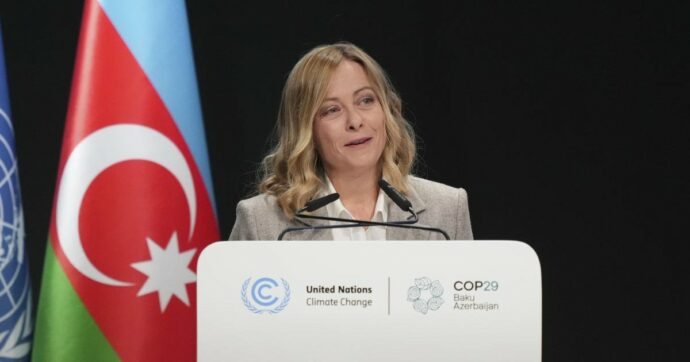
Infine, prima di lasciare l’Azerbaijan, la presidente del Consiglio non si è affatto dimenticata che Confindustria sta chiedendo nucleare a man bassa e non le è sfuggito che esso servirà anche per alimentare l’Intelligenza Artificiale, alludendo, quindi, non solo ai presunti reattori di nuova generazione cui è affezionato Pichetto Fratin, bensì anche ai piccoli reattori (SMR) che i suoi suggeritori – a partire da Eni – reclamano ad ogni occasione.
In tal modo, ripiega sullo sfondo la posta di una conversione energetica irrimandabile, consapevolmente ritardata al riparo di un disegno dirompente: puntare alla riduzione delle emissioni – come vorrebbe Trump – solo dopo un’eventuale conquista di egemonia derivante da una incessante guerra mondiale a pezzi, in cui le emissioni dovute agli eserciti stanno superando ogni limite. Non si va, pertanto, ad una rottura ora con le fonti fossili: anzi, la si allontana nel tempo come sostitutiva alle rinnovabili e, contemporaneamente, non si procede ad un contenimento dei consumi.
Il negazionismo, prima sparso a piene mani, prova ora a giocare carte nuove, cercando di convincere che, impugnando nel futuro un approccio tecnocratico rischiosissimo si potrà anche decarbonizzare, ma ricorrendo, al CCS, all’ingegneria climatica e, infine, all’ossimoro del nucleare sicuro, se non addirittura all’energia da fusione, “pulita, sostenibile e illimitata”. Nel frattempo, chi perde sono cittadini e le imprese ed anche le casse dello Stato, che rimangono legate ai prezzi alti dell’energia, trainati dal costo del gas.
Proprio dal fallimento delle Cop, occorre ricordare che lo sforzo di persuadere le persone della necessità di agire per il clima e la pace in modo estremo è stato lasciato quasi interamente al settore privato o a quello del volontariato, nonostante che questo sia il più grande problema che l’umanità abbia mai affrontato.
Alle posizioni ormai coincidenti di governo e Confindustria occorre rispondere innanzitutto con una convinta mobilitazione contro l’imbroglio del nucleare e per un bene comune tanto essenziale come il clima, che tocchi le istituzioni a tutti i livelli ed abbia un carattere di ubiquità: se tutti dovessero ascoltare lo stesso messaggio nello stesso momento e se questo messaggio facesse appello direttamente a un nucleo morale comune, tenderebbe finalmente ad essere preso sul serio da chi si sente defraudato.
postato da angelo consoli @ 09:51
0 Commenti

Ormai, le rinnovabili hanno dimostrato di essere meno costose delle fonti fossili con cui ci guadagnano solo i petrolieri, mentre con l'energia rinnovabile è di tutti e tutti ci guadagniamo. Tutti: imprese, Comuni, cittadini, scuole, comunità!
E le fonti fossili, ci dice il Lazard Institute con i suoi rapporti annuali, costano molto di più delle energie rinnovabili (1)
Ecco perché hanno bisogno dei finanziamenti governativi: 7000 miliardi di dollari di contributi e sovvenzioni alle industrie del petrolio e del gas solo nel 2022. SETTEMILA!!! (2)
Ma non solo non si approvano provvedimenti per impedire l'inquinamento e il cambiamento climatico determinato dallo sfruttamento dei combustibili fossili, ma nessuno fa niente neanche per eliminare questi inammissibili e vergognosi contributi ai petrolieri.
Eccola l'ipocrisia della COP. Di questa, come di tutte le altre COP.
Ascoltiamo i nostri ragazzi oggi perché domani sarà troppo tardi. Capito Baku?...
(1) https://www.lazard.com/media/2ozoovyg/lazards-lcoeplus-april-2023.pdf
(2) https://www.qualenergia.it/articoli/sussidi-combustibili-fossili-7000-miliardi-pari-7-percento-pil-mondiale/
Il
nostro mondo è in fiamme, e lo è anche la nostra coscienza. Mentre i
leader si riuniscono per la COP29, pretendiamo di più di parole vuote. | |
| |
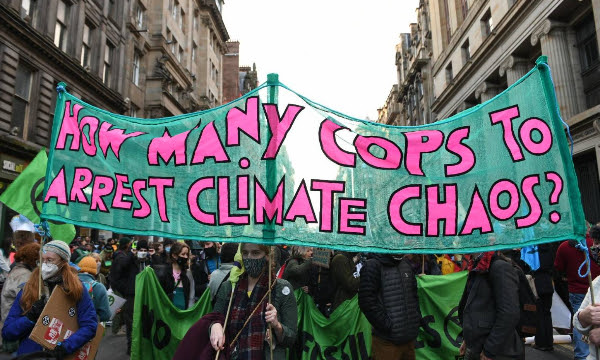
Unitevi a noi per denunciare l'ipocrisia del governo del Regno Unito.
Sono complici del processo COP che riguarda più accordi loschi con le
compagnie petrolifere e del gas che azioni significative e urgenti. | |
| |
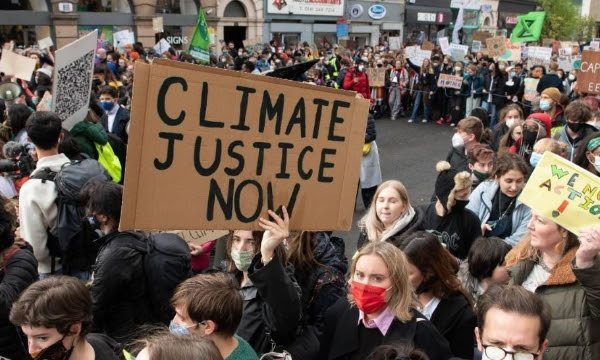
Stiamo uniti perché i diritti umani e la giustizia climatica sono inseparabili. Marciamo per un futuro giusto ed ecologico, per tutti. |
postato da angelo consoli @ 08:34
0 Commenti

Iscriviti a
Post [Atom]